
17 walking spots tagged “Coast”. Near 逗子・葉山駅 and 12 other areas.
A beach in Hashirimizu, Yokosuka, facing Tokyo Bay. The Boso Peninsula can be seen across the water.
A rocky shore on the south side of Jogashima Island. It lies along the rocky-shore walk leading to Umanose Domon.
A beach facing Sagami Bay, located between Hayama and Akiya. It runs along National Route 134 and looks across the bay to Mt. Fuji.
An artificial headland known as a "T-bar", built to prevent erosion of the sandy shoreline. The areas on either side of it are excellent surf breaks as well as fishing spots.
In 1885 (Meiji 18), the military surgeon Jun Matsumoto took note of the health benefits of sea bathing and opened a bathing beach at Oiso, which is said to mark the beginning of Japan's sea-bathing culture. Afterward, figures such as Hirobumi Ito, Shigenobu Okuma and Shigeru Yoshida built villas here, and a seaside summer-retreat culture flourished. A calm atmosphere still lingers along the shore today.
A vast stretch of sand spreading out on the west side of the mouth of the Sagami River. Beach soccer, beach volleyball, running, walking — some kind of match or event is going on here all year round, with Shonan Bellmare Hiratsuka Beach Park at the center of it. The sky opens up wide, and on clear days Mt. Fuji looms large.
The coast where Yuzo Kayama and Keisuke Kuwata brought West Coast surf music to Japan, and where Southern All Stars turned local everyday life and the wistfulness of summer's end into song. The shoreline running from Southern Beach Chigasaki to the Yanagishima Coast is regarded as the birthplace of the "Shonan Sound." Eboshi Rock stands just offshore, with residential streets and surf shops spreading out behind.
Less crowded with tourists than Enoshima or Kamakura, this is a beach where you can see the everyday life of the people who live in Shonan. The pine grove stretching along the back of the sand is what remains of a windbreak forest planted in the Edo period to stop blowing sand. Before the war there was a navy training ground here. On weekends, runners and dog walkers gather. Because you can also commute to central Tokyo by train, it has become a popular area for people relocating to Shonan.
The beach on the west side of Enoshima. Surf shops line the street and many surfers chase the waves. Enoshima's yacht harbor lies right in front. The image of "Shonan" that Japanese people picture was born around here.
The beach on the east side of Enoshima. Together with Nishihama and Kugenuma, the stretch of sand runs about 1.6 km; in the 1960s it was the setting for the "Wakadaisho" series starring Yuzo Kayama, and it later developed into a mecca for surfing and beach volleyball. Higashihama is a swimming beach where families gather.
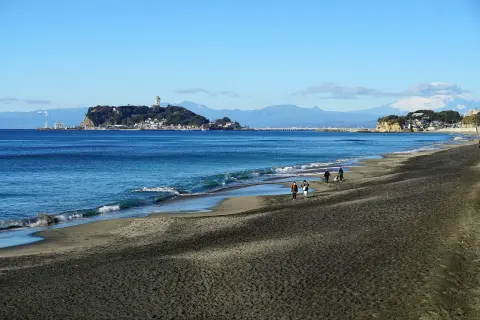
A shore looking out on the Izu Peninsula, Mt. Fuji and Enoshima to the right, Oshima straight ahead, and the Miura Peninsula to the left. Here are Kamakura High School, said to be the model for Ryonan High School in "Slam Dunk," and Shichirigahama High School, also said to be the model for the school Peco and Smile attend in "Ping Pong." Surfers are a constant presence, but swimming is prohibited.
A beach within walking distance of Tsurugaoka Hachimangu Shrine and the Great Buddha of Kamakura. In summer, seasonal beach houses line the shore. The Kamakura Fireworks Festival is held here every summer (July 10 in 2026), known for its underwater fireworks that spread out in a fan shape across the surface of the sea. Locals pronounce "Yuigahama" with the accent on the "yu".
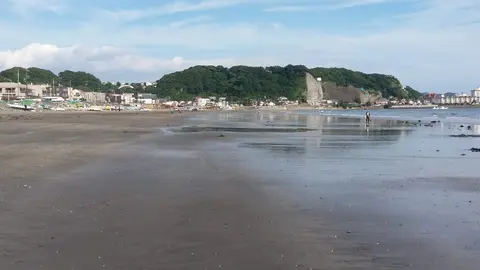
A beach that flourished as the sea gateway of the Kamakura shogunate. At its eastern end lies Wakaejima, built in 1232 and considered the oldest surviving harbor ruins in Japan. As there is no developed fishing port, fishermen load their boats onto carts and push them across the sand to put out to sea. There is a direct-sales stand of "Monzamaru," which sells whitebait caught that morning, and in the early mornings of summer you can see people waiting for the catch to be landed.
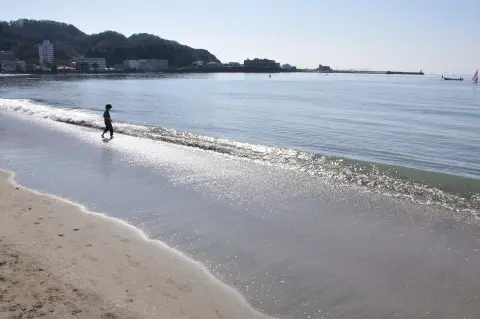
In the 1950s, this was the beach where the young "Taiyozoku" (Sun Tribe) depicted in Shintaro Ishihara's "Season of the Sun" gathered. Hayama Marina opened in the 1960s, and heading out to sea by yacht caught on as a pastime. It is still lively today with people doing SUP and windsurfing. Ishihara's former residence stands near Hiroyama Park, which overlooks the beach.
The beach that best represents Hayama, an area that developed from the Meiji era onward as a villa retreat for political and business figures and cultural celebrities. In 1956, the film "Crazed Fruit" starring Yujiro Ishihara was shot in the surrounding area, spreading the image of Hayama as "the sea of the young." In the 1960s and 70s it became a go-to beach where students from Tokyo gathered, and Haruomi Hosono and Takashi Matsumoto also played at the summer beach huts during their amateur band days. The Yujiro Lighthouse stands on a reef offshore.
A beach spreading out in front of the Hayama Imperial Villa, known for its clear water. Behind the villa, Koiso-no-Hana and the Shibasaki Coast have wide rocky shores where tiny creatures live right beside the swimmers. It is also the sea where Emperor Showa and the Emperor Emeritus walked for their marine biology research, collecting sea slugs, sea anemones, gobies and more. Mt. Fuji and the sunset can be seen from here as well.
The "Statue of Peace" by Namba Magojiro, standing in Shonan Kaigan Prefectural Park, and the surrounding beach. It serves as a landmark for Kugenuma's surf spots.